
Table of Contents
Any person who is new to the Indian Banking system will always wonder what financial services do banks provide in India. They are confused about the different banks and their facilities. Many people who visit India are also worried if they can transfer money from India through banking system or not. Well, not to worry any-more, this article will cover most of the financial services that banks provide in India.
Over the last decade, banking has become more digitalised than ever. Many new services have added into banking system that have made banking more flexible and time saving. Earlier, the prominent services that were available in Indian banks were depositing money, withdrawing money or creating term deposits such as fixed deposits or recurring deposits.
However, now banks are synonymous with financial hubs as they have variety of financial services other than existing ones. The new services include loans, investment products, insurance as well as business products.
Since the start of demonetisation in 2015, there has been a revolution revolving around UPI payment system. Almost most businesses and citizens adopted this digital system, which helped improve the transaction system across India. Many mobile apps dedicated to UPI Payment were simultaneously launched across India such as PhonePe and Google Pay.
Even though UPI payment apps are also nowadays getting involved in banking services, many users prefer traditional banks over UPI payment apps for banking services.
As someone who has personal experience with both traditional banking system as well as UPI system, I would love to elaborate about the strengths and weaknesses of both systems through this guide.
Keeping this guide complete beginner friendly, I would try to simplify the different financial services that banks provide, explain how these services work and how can a salaried employee, small business owner or a first time user can utilise these services wisely.
What Are Financial Services Provided by Banks?
In India, there are different types of banks as decided by RBI and ownership of banks. Nowadays, banks can be considered as financial hub as financial services provided by banks to their customers can help in creating financial ecosystem.
Previously these banks were only considered as money storage facility, however these days banks have a very large variations in facilities that make them more than just money storage facility.
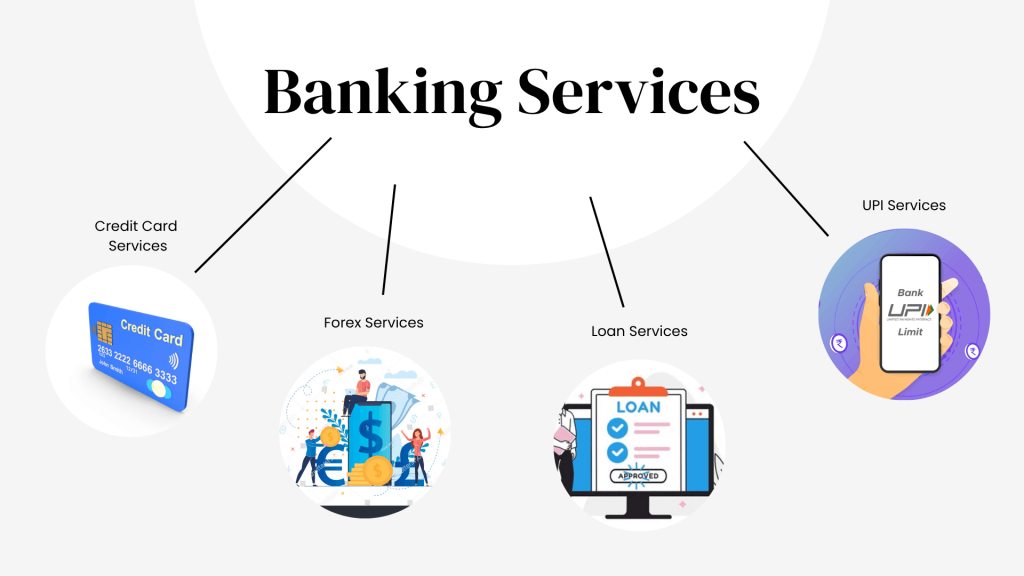
Current financial services allow its customers to grow their money as well as make investment and also borrow loans.
Most banks across India provide the following services mentioned below:
- Savings accounts
- Current accounts
- Fixed deposits
- Loans
- Credit cards
- UPI and digital wallets
- Netbanking and mobile banking
- Demat services and Investment products
- Insurance services
- Forex services
- Business banking solutions
- Locker Services
Let us understand each of these services in detail.
1. Savings Accounts
The most common service that customers sought after at a bank is savings account. Almost 89% of people have savings account in India. Saving account allow customers to deposit money which is kept securely and an interest is also paid quarterly to customers.
A savings account allows customers to:
- Deposit money safely
- Earn interest
- Withdraw cash anytime
- Use UPI and online payments
- Access ATM and debit card facilities
For salaried employees and first-time banking users, a savings account is usually the starting point of their financial journey.
Most modern savings accounts also include:
- Mobile banking
- SMS alerts
- QR payments
- Online fund transfers
- Bill payments
- Auto-debit facilities
From my personal experience, I can admit that private banks are more focused on opening savings account than PSU banks. In a private bank such as HDFC or Axis Bank, employees make the process of opening bank account smoother as opening an account can take mostly 2 days. While PSU banks need at least a week for opening a saving account.
Even though private banks provide better banking experience, PSU banks have wider banking network. Many SFB (Small Finance Banks) such as Utkarsh Small Finance Bank are covering the gap between PSU banks and private banks. SFBs have dedicated zones where its branches are present in many small towns and villages.
2. Current Accounts
Current account are one of the vital requirement for running a business. Current account has no limits on depositing and withdrawing money which is necessary for businesses. It helps in smooth operation of business and also provides option of overdraft.
For any new business owner, opening a current account is necessary for smooth transactions with vendors and other businesses.
Following are facilities that a current account holder gets:
- Overdraft facility
- Bank can collect money on behalf of customer and credit it in customer’s account.
- Electronic Funds transfers
- Customers can make direct payment to vendors and their clients
Even though it comes with these facilities, customer need to maintain AQB (Average Quarterly Balance) in current account, otherwise there is a chance of penalty.
However, as I have heard that opening a current account is less smoother when compared to opening a savings account.
3. Fixed Deposits (FDs)
Fixed Deposits are considered as one of the safest investment in India apart from investments in Indian Post Office and Indian government bonds.
Fixed Deposits provides following facilities to customers which makes it a good investment instrument :-
- Bank is bound to pay a guaranteed interest on the amount kept as Fixed Deposit
- The interest rates for Fixed Deposit is very stable and therefore guaranteed returns are possible.
Fixed Deposits are favourite among customers such as:
- Conservative investors
- Senior Citizens
- People with less financial literacy
Fixed Deposits are also very helpful if you are thinking of creating an emergency fund. We know that emergency funds should be predictable and therefore having a fixed deposit serves this purpose.
Fixed Deposits also helps to meet short term financial goals as both time period and returns are predictable.
Many Indian families have indispensable trust on Fixed Deposits due to their lower risk and predictable returns.
In my opinion, Fixed Deposits are one of the best investment instrument that a bank offers to its customers. If you have disposable income that you do not need to use for at least one year, you can use it to create a Fixed Deposit and enjoy returns over it.
4. Loan Services
Most Banks provide loan services for its customers as it provides a win-win situation for both bank and customers. Nowadays, loans service is one of the most promoted service banks provide in India.
Different loan services provided by banks are as follows:
- Home loans
- Personal loans
- Education loans
- Car loans
- Gold loans
- Business loans
Obtaining a loan helps individuals and businesses increase their capital for short duration which can help them deal with different purposes such as purchasing flats or cars, paying vendors or increase productivity of their businesses.
Home loans and personal loans are more commonly used by salaried employees.
For small business owners, banks provide:
- Working capital loans
- MSME loans
- Overdraft facilities
- Machinery financing
For banks, lending loans is a core banking activity as most of its profit is gained from loan interest. However, obtaining a loan also depends on type of banks.
In my opinion, getting a loan from a private bank is much more easier when compared to PSU banks. In private banks, approval take much less time than a PSU bank. However, the interest rates of PSU bank is lesser than Private bank.
5. Credit Cards
Previously, credit cards were popular among businessmen and were exclusive service that banks provide in India to high income customers only. However, nowadays, most Indian banks aggressively promote their Credit cards. Many banks also remove joining fees as well as annual fees to promote their credit cards.
Most credit cards have following features with them:
- Reward points
- Cashback
- EMI conversion
- Travel benefits
- Short-term credit
Personally, I found it very annoying that salesperson of credit cards can be found everywhere trying to pitch why their credit card is necessary for the customer. You can find salesperson in malls, marts trying to sell credit cards. I have seen SBI cards salesperson in various malls looking for potential customers. I also experience multiple telephone calls from Axis Bank trying to sell credit card. Even though credit cards are useful, many customers are just pressured into accepting these products even if they do not have any requirement.
This is why first-time banking users should always:
- Read terms carefully
- Understand annual charges
- Avoid overspending
- Never miss payment deadlines
A credit card is helpful only when used responsibly, otherwise there can be hefty penalty on credit card usages.
6. UPI and Digital Payment Services banks provide in India
Since Demonetisation in 2015, UPI has closely integrated into life of common man in India. It has made transferring money so smooth that many people have stopped carrying money in their wallet. UPI allows users to connect their bank account to their UPI app and then transfer money to anyone.
Banks have accepted UPI services with open arms. Most banks have integrated UPI into their bank apps. Moreover, government of India has launched BHIM app for the sole purpose of UPI payment. UPI service is the most commonly used services that banks provide in India.
However, today most Indians are users of following apps for UPI payment:
- PhonePe
- Google Pay
- Paytm
These apps are directly connected to bank accounts and allow instant payments within seconds.
Banks support UPI by:
- Linking customer accounts
- Processing transactions
- Managing payment infrastructure
- Ensuring security verification
The biggest advantage of UPI is convenience. Even small shopkeepers, vegetable vendors, and local businesses now accept digital payments.
Recently, government is also working on developing UPI wallets, where you can deposit money and transfer it directly without any internet connection.
India’s banking system has progressed rapidly because of this digital revolution. Financial inclusion has increased dramatically, and people who previously depended only on cash are now using online banking daily.
7. Netbanking and Mobile Banking
Banks do offer Netbanking and Mobile Banking services for its customers to make banking process hassle-free. Both Netbanking and Mobile Banking provides similar services with difference being that Netbanking is used through browser and website visit to Bank’s Netbanking website. In case of Mobile Banking, customer can download the mobile app of the bank and use it to access mobile banking services. These services allow customer to operate their bank accounts and perform other tasks on their account without visiting bank branch.
Using netbanking or mobile banking apps, customers can:
- Transfer money
- Pay bills
- Open FDs
- Check account balances
- Download statements
- Manage debit cards
- Fill forms such as Form 121
- Apply for loans
This is one area where private banks often outperform PSU banks.
In my experience, apps from Axis Bank and HDFC Bank are generally more user-friendly and stable. PSU banks occasionally face internet downtime or technical issues that affect customer experience.
Still, PSU banks are improving quickly as digital banking competition increases.
8. Demat services and Investment products
Modern Indian banks have investment products that are offered to customers which were not available in earlier years. Also Demat services are included in these services that banks provide in India.
Most of these services include:
- Mutual funds
- Demat services
- SIP investments
- Government bonds
- Retirement plans
In most cases, banks often partner with different financial institutions to sell these products. These products include either mutual funds or SIP plans.
This is useful for beginners because they can manage:
- Savings
- Investments
- Banking
- Payments
Thus, multiple services are available to customer which means all in one ecosystem.
However, customers should act in their own discretion as investing without proper information can be disastrous. In many cases, relationship manager only need to sell their products to earn incentives and they do so without caring about the after- effects on the customer.
9. Insurance Services that Banks provide in India
These days most insurance services banks provide in India, whether it is life insurance or car insurance. Most banks act as insurance distributors earning commission on successfully selling insurance scheme to its customers.
Banks mostly offer:
- Life insurance
- Health insurance
- Vehicle insurance
- Travel insurance
This collaboration between bank and insurance company is often termed as bancassurance.
Many customers prefer buying insurance through banks because they already trust their banking institution.
However, even if one is ready to buy an insurance policy from bank, the person should understand all terms and conditions that are concerned with the policy. The person should also check premium amount and what facilities does the insurance provides.
10. Forex Services
Forex services is necessary for people who have some close relatives in foreign country. Many banks provide in India forex services for transferring funds to another person who is living in foreign country. Using forex services, customer can also receive funds from outside country too.
There are many features of forex services that banks provide in India. Some of them are mentioned below:
- Foreign currency cash as well as forex travel card
- Remittance from outside country
- Foreign currency account
For large businesses, these facilities banks provide in India:
- Trade Finance Services
- Dedicated Treasury Desk
- Hedging and Risk Management
Before making any forex transactions or account, you need to check multiple banks to find the most suitable and effective bank.
11. Business Banking Services
There are many business services that banks provide in India. These services are focused on small businesses as many businesses want to use banking services to increase customer footfall. In many cases, customers want to pay using UPI, and therefore businesses need a bank account to deposit the money that customer transfer through UPI payment.
Services that most banks provide:
- Current accounts
- GST payment solutions
- POS machines
- QR payment systems
- Payroll management
- Vendor payment solutions
Digital banking has made life easier for small business owners.
Today, even small shops can:
- Accept UPI
- Track payments instantly
- Maintain digital transaction records
- Access business loans faster
India’s banking ecosystem is becoming increasingly business-friendly because of digitisation.
12. Locker Services
Most banks have locker facility in their branches where customers can keep their valuable items. It is useful when you are out of town and insecure about the valuable item.
This service banks provide in India considering the amount of gold people keep in their home. When people visit outside city, many find it insecure to keep such valuable in their home fearing theft and robbery.
Most banks charges annual fees for locker facility depending on size of locker. However, lockers cannot be used to keep certain items. If found these items, banks can cancel the agreement of locker.
Here, you will find the items that are not allowed to be stored in lockers in a bank.
Traditional Banks vs Fintech Apps
Fintech Apps are constantly evolving and provide a vast number of features to customers including those features that banks provide in India to their customers. Due to these features, many customers prefer Fintech Apps for many transactions when compared to banking services.
In India, there are many competing Fintech apps, however most popular apps are:
- PhonePe
- Google Pay
- Paytm
offer speed and convenience.
However, fintech apps are still dependent on banks underneath.
Banks continue to provide:
- Account infrastructure
- Regulatory compliance
- Loan systems
- Deposits
- Financial security
In simple words:
- Fintech apps improve convenience
- Banks provide the financial backbone
Both are now working together rather than competing directly.
How Do Banks Make Money?
Many times we wonder that so many services banks provide in India and not any specific fees is charged by banks. Then how does a bank generate money to remain sustainable. So let me point out the different methods that banks make money.
Banks mainly make money through:
- Loan interest
- Credit card charges
- Processing fees
- Investment commissions
- Insurance commissions
- Penalties and service charges
For example:
- Banks pay lower interest on savings accounts
- Banks charge higher interest on loans
- The difference becomes profit
This is why banks strongly promote loans and credit products. Such products have high interest rates which allow banks to keep a safe margin even if they pay interest on saving account.
Common Banking Mistakes to Avoid
Let me point out the common mistakes that people makes when banking. Even though there are many services banks provide in India, it is necessary that customers have proper understanding of financial instruments. Avoiding these mistakes can make your life stress free and will allow you to enjoy banking services at its fullest.
For Salaried Employees
- Keeping all savings in one account
- Ignoring emergency funds
- Taking unnecessary personal loans
- Overspending through credit cards
- Not checking bank charges
For Small Business Owners
- Mixing personal and business accounts
- Ignoring cash flow tracking
- Not using digital payment systems
- Delaying GST and vendor payments
- Depending entirely on cash transactions
For Everyone
- Sharing OTPs
- Clicking suspicious links
- Ignoring fraud alerts
- Using weak passwords
- Falling for fake customer care calls
Digital banking has extreme usefulness, however, it is needed that person using digital banking is cautious against digital frauds that frequently occurs.
It is important to notice that never any employee of bank will ask for OTP or PIN. Neither any employee will ask you to download any kind of form from Whatsapp.
The Future of Banking in India
The future of banking services is full of optimism with the onset of digitisation. India has already the largest number of digital transactions occurring everyday.
India has already become one of the global leaders in digital payments because of:
- UPI adoption
- Affordable smartphones
- Internet accessibility
- Government-backed digital initiatives
Today, you can find UPI Payment app in almost any smartphones across small towns in India. Digitalisation has allowed even small shops to keep QR codes to accept UPI Payment.
Private banks are always ahead in providing better customer experience by appointing relationship manager to their customers which is absent in case of PSU banks. However, many PSU banks are trying to uplift their images and providing better customer services nowadays.
From my experience, Indian banking still has some issues like aggressive product selling and occasional technical failures in PSU banks. However, banks are trying to improve the experience of customers irrespective of whether bank is a PSU bank or Private bank.
The combination of:
- Traditional banking infrastructure
- Fintech innovation
- Digital payments
- Financial inclusion
is creating a stronger financial ecosystem for millions of Indians.
For salaried employees, small business owners, and first-time banking users, understanding banking services properly can make a huge difference in managing money wisely and building long-term financial stability.